GENERATIVE ENGINE
OPTIMIZATION
A practitioner's guide to GEO: the mechanics of how AI engines pick who to name, the techniques with published evidence behind them, the crawler and content work that follows, and how to measure any of it.
This is the pillar guide: the basics, a tutorial-style roadmap, and the technical detail underneath both. Spelled generative engine optimisation outside the US, and abbreviated GEO, which in a search-engine-optimization context means this and not geographic targeting. For the shorter definitions, read what AI SEO is or what AI visibility is. If you would rather start with your own numbers, run CITED's free AI visibility check and come back to the roadmap with a baseline.

What is generative engine optimization?
Generative engine optimization (GEO) is the practice of getting your brand named, and your pages cited, inside answers written by AI engines: ChatGPT, Google AI Overviews and AI Mode, Gemini, Perplexity and Claude. It optimizes for retrieval and synthesis rather than for a ranking position, and is measured by mention rate across real buyer questions.
Why GEO exists
The thing that broke the old model is not that AI answers are better. It is that they end the session. The Pew Research Center tracked 68,879 real Google searches from 900 US adults and found that when an AI summary appeared, people clicked a traditional search result on 8% of visits, against 15% of visits without one. Clicking a link inside the summary happened on 1% of visits (Pew Research Center, July 2025).
Read that second number again, because it sets the whole strategy. Being the source under an AI answer is worth almost nothing in clicks. What is worth something is being named in the answer itself, because that is what the reader takes away and searches for later. GEO that chases referral traffic is optimizing the 1%. GEO that chases mentions is optimizing the recommendation.
The traffic that does arrive is unusually good, which is the other half of the case. Ahrefs published 30 days of its own analytics showing AI search at 0.5% of visits but 12.1% of signups, roughly a 23x conversion rate against organic search (Ahrefs, June 2025). The mechanism is not mysterious: the engine did the comparison shopping before the click, so whoever arrives has already been pre-sold. Semrush puts the average AI visit at about 4.4x the value of an organic one and projects AI search visitors overtaking traditional search visitors around 2028.
So the opportunity is asymmetric. AI referrals are still low single-digit percentages of most sites' traffic, which is exactly why your competitors have not staffed this yet, and the visitors are worth several times what your existing organic visitors are worth. That gap is the entire argument for doing GEO now rather than in two years.
Generative engine optimization vs. SEO
The honest answer to "is GEO just SEO again?" is: about 80% of it is, and the other 20% is genuinely new. Crawlability, server-side rendering, clean information architecture, topical depth and being cited by other people are the same levers they always were. Google's own documentation is blunt about the overlap: its guidance for AI features says to focus on "creating helpful, reliable, people-first content" and that there is no special markup you need (Google Search Central).
What is new is the unit of competition. A ranking is a list position, so ten results fit on a page and being sixth still gets you seen. An AI answer is a paragraph, so three or four brands fit and there is no page two. That changes the target from "rank for a keyword" to "be one of the handful of entities the model associates with this category", which is closer to brand and PR work than to on-page optimization.
| Dimension | Classic SEO | GEO |
|---|---|---|
| The unit you win | A position in a ranked list of ten | A named mention inside one written answer |
| How many win | Ten per page, plus page two | Three or four brands, no page two |
| The query you target | A short keyword with known volume | A conversational question, plus the sub-queries the engine fans it out into |
| What decides it | Links, on-page relevance, authority | Retrievability, quotable structure, and consistent third-party consensus about you |
| Where the win happens | On your page, after the click | Off your page, inside the answer |
| The metric | Ranking position and organic sessions | Mention rate across a prompt set, plus share of voice |
| Feedback speed | Weeks to months, and mostly stable | Days, and volatile: the same prompt can answer differently tomorrow |
How does GEO work?
You cannot optimize a process you have not looked at. Almost every bad GEO decision comes from imagining the model is answering from memory, when for anything commercial it is usually running a search and reading the results. Those are two different systems with two different levers.
The model's training data is frozen and enormous, and you cannot meaningfully edit it. What it does hold is a rough prior about which brands belong in which category, built from years of the open web, and that prior is why a model will confidently list your competitor before searching anything. The retrieval layer is live, and it is where the work happens: the engine fires searches, fetches pages, and writes an answer grounded in what came back. Retrieval is winnable this quarter. The prior is a two-year brand project.
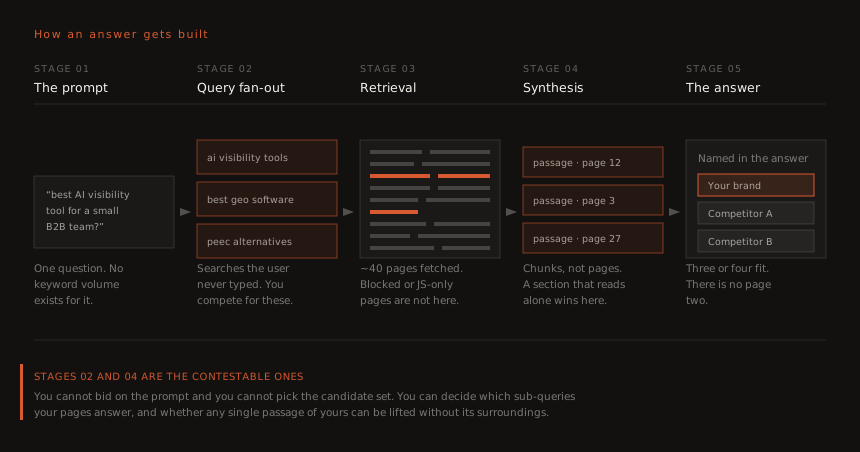
The prompt arrives, and it is not a keyword
"What's the best AI visibility tool for a small B2B team?" carries a category, a constraint and a buyer stage. There is no keyword volume for it, which is why prompt research cannot be done in a keyword tool.
The engine fans it out into sub-queries
One question becomes several searches, often ones the user never typed: "ai visibility tools comparison", "best geo software for small business", "[competitor] alternatives". You are competing for the fan-out, not the prompt. This is why comparison and alternatives pages punch above their weight.
It retrieves and reads a candidate set
Usually a few dozen pages. A page that needs JavaScript to show its content, or that a crawler is blocked from, simply is not in the set. Nothing downstream can fix that.
It synthesizes an answer from chunks, not pages
The engine lifts passages, not documents. A 3,000-word page where no single passage answers a question standalone will lose to a 300-word section that does. Optimizing at page level is the most common structural mistake in GEO.
It names brands and, sometimes, cites links
Mentions and citations are separate outcomes and they come apart constantly: you can be named without being linked, and linked without being named. Track both, and expect the mention to be the one that moves revenue.
GEO best practices that have evidence behind them
Most GEO advice is assertion. There are two pieces of work worth building a content standard on, and between them they explain most of the wins we see.
The first is the paper that named the field. Aggarwal et al., GEO: Generative Engine Optimization (KDD 2024), built a 10,000-query benchmark and tested nine content edits to see which raised a source's visibility in generated answers (arXiv:2311.09735). The headline is a lift of up to 40%, but the useful part is the ranking. The three best edits were adding quotations from credible people, adding statistics in place of vague claims, and citing sources. The worst of the nine was keyword stuffing. The pattern is that what wins is the stuff that makes a passage safe to repeat: an engine that has to stand behind an answer prefers material that is already attributed.
The second is positional. Kevin Indig's analysis of roughly 1.2 million ChatGPT answers found 44.2% of citations were drawn from the first 30% of a page's content, with the remainder split across the middle and the end. The practical reading is not "write short pages". It is that burying your answer six paragraphs into a warm-up costs you the citation, and moving it to the top is usually a one-hour edit rather than a rewrite.
Put those together and you get a content standard with evidence behind it: answer in the opening, attribute your numbers, quote named people, and stop padding. Note how much of that is also just good editing. GEO techniques that would embarrass you in front of a human editor are generally the ones that do not work.
The technical layer
Technical GEO is a short list and the tips below are nearly all prerequisite work: it does not win you mentions, it stops you being invisible. Do it once, verify it, move on to content. The single most common own-goal is a robots.txt rule written to block AI training that also blocks AI search.
Those are different crawlers, and the distinction is worth learning properly because it is where good intentions cost real visibility. Blocking GPTBot opts you out of OpenAI's model training and does nothing to ChatGPT's search citations. Blocking OAI-SearchBot removes you from ChatGPT search. Blocking Google-Extended opts out of Gemini grounding and training, and has no effect at all on AI Overviews or AI Mode, which run on Googlebot. If you block Googlebot to keep out of AI Overviews, you have also left Google Search.
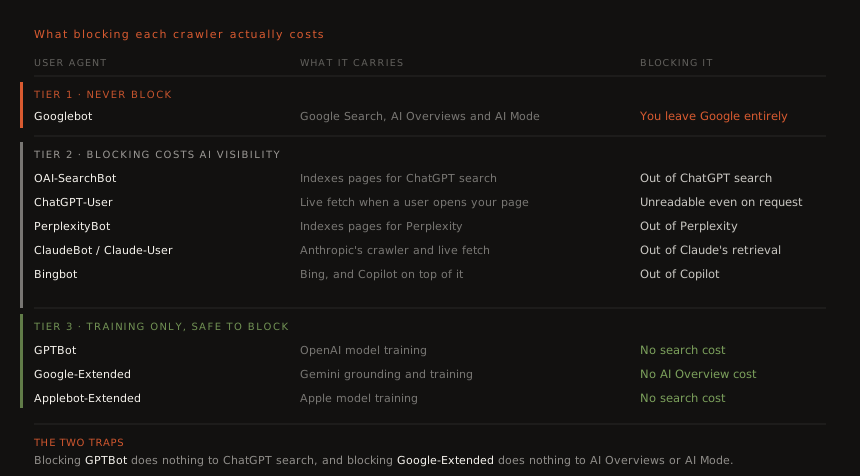
| User agent | What it does | Blocking it means |
|---|---|---|
Googlebot | Google Search, AI Overviews and AI Mode | You leave Google entirely. Never block this. |
Google-Extended | Gemini grounding and model training | Out of Gemini. No effect on AI Overviews or AI Mode. |
OAI-SearchBot | Indexes pages for ChatGPT search | Out of ChatGPT search results. Usually the costliest block. |
ChatGPT-User | Live fetch when ChatGPT opens a page for a user | ChatGPT cannot read your page even when a user asks it to. |
GPTBot | OpenAI model training | Training opt-out only. Does not affect ChatGPT search. |
PerplexityBot | Indexes pages for Perplexity | Out of Perplexity's index. |
ClaudeBot / Claude-User | Anthropic's crawler and live user fetch | Out of Claude's retrieval. The fastest-growing referrer of the set. |
Bingbot | Bing, and Copilot on top of it | Out of Copilot, and out of anything else grounded on Bing. |
Technical GEO best practices: four checks
Serve your content in HTML, not JavaScript
View source, not inspect element. If your main copy, title, canonical or structured data only exist after JS runs, assume a share of AI crawlers never see them. Google's own AI guidance is to make sure important content is "available in textual form". Server-side render or pre-render the pages you want quoted.
Make your schema match your visible text
There is no GEO-specific schema type, and Google says so directly. Organization, Article, Product and FAQPage are enough. What matters is the instruction most people skip: the markup must match what the reader sees. Markup describing content that is not on the page is worse than no markup.
Fix the speed of the pages you want cited
Retrieval happens under a timeout. A page that takes four seconds to return its HTML is competing against pages that took 400ms, and it loses some fraction of the time for reasons that have nothing to do with its quality.
Give every quotable page a date and a named author
Engines lean on recency and attribution when choosing between two adequate sources. A visible byline with a real credential, a datePublished, and an honest dateModified cost nothing and break the tie. Backdating or fake-refreshing dates is the version of this that gets you dropped.
Do you need an llms.txt file?
Short answer: it will not help you in Google, and most GEO guides that recommend it have not checked. This is worth being precise about, because it is the single most over-prescribed tactic in the field.
Google has said no, repeatedly and on the record. Gary Illyes confirmed at Search Central Live that Google does not support llms.txt and has no plans to. John Mueller compared it to the keywords meta tag, which is a pointed comparison: a file where the site owner declares what the site is about is exactly the kind of self-report search engines learned to ignore decades ago. Google's AI features documentation now states it plainly: "You don't need to create new machine readable files, AI text files, or markup to appear in these features" (Google Search Central).
So why does CITED's own action plan still suggest publishing one? Because the cost is an afternoon and the downside is zero, some non-Google tooling does read it, and the exercise itself is genuinely useful: writing down the ten pages you want quoted, each with a sentence on what it covers, forces the prioritisation most teams have never done. Treat it as free hygiene and a planning artifact. Do not treat it as a lever, do not put it in phase one, and be sceptical of any GEO vendor whose recommendation list opens with it.
How to optimize content for GEO: writing that gets cited
This is where GEO is actually won, and the rules follow directly from the mechanics: engines lift passages, they prefer attributed material, and they read the top of the page hardest.
One page, one question, answered first. Open with a 40 to 60 word answer that stands alone if lifted with no context. Then earn the rest of the page. If your first paragraph is scene setting, you have donated the citation to whoever was more direct.
Write in self-contained chunks. Every H2 section should make sense pulled out on its own, which in practice means roughly 130 to 170 words, no "as mentioned above", and the subject named rather than pronouned. Question-shaped headings help, because they match the shape of what the engine is looking for.
Attribute everything numeric. This is the highest-leverage habit in the whole discipline and the KDD study backs it: quotations, statistics and citations were the three best-performing edits of the nine tested. "Conversion improved significantly" is unquotable. "Conversion rose from 2.1% to 3.4% over six weeks (internal data, n=1,840)" is a sentence an engine can safely repeat.
Use tables and lists for anything comparative. A table is pre-chunked, unambiguous data. Comparison content is cited disproportionately across every dataset published on this, which is a strategic hint as much as a formatting one: build the "X vs Y", "best X for Y" and "alternatives to X" pages for your category, and be genuinely fair in them.
Here is the difference in practice, on the same underlying facts:
| Passage | Why | |
|---|---|---|
| Before | "AI search has changed the game for marketers. As generative engines become more sophisticated, brands are discovering that traditional approaches to visibility no longer deliver the results they once did, and forward-thinking teams are adapting their strategies accordingly..." | 62 words, no claim, nothing to attribute, answers no question. There is nothing here an engine could lift. |
| After | "AI answers end most sessions rather than passing them on. Pew Research Center tracked 68,879 Google searches and found users clicked a result on 8% of visits with an AI summary, against 15% without; only 1% clicked a link inside the summary (Pew, July 2025). The implication for brands is that being named in the answer matters more than being linked under it." | 58 words, one specific claim, a named and dated source, a stated implication. Self-contained if lifted with zero surrounding context. |
Where the models actually look
The hardest thing for an SEO team to accept about GEO is how much of it happens on pages you do not control. Ask any engine to recommend software in your category and watch what it cites: roundups, review platforms, Reddit threads, industry media, YouTube. Your own site tends to appear as corroboration, not as the basis of the recommendation. That is rational behaviour. A brand's own claim that it is the best option is the least informative source available.
So the off-site programme is the strategy, not the nice-to-have. Run it in this order. First, identify the gaps by finding out what is already being cited for your category's prompts, because that list is your actual target list and it is usually nothing like your backlink prospect list. Second, get correctly listed in the roundups that appear: being absent from "best X tools" articles the engines lean on is a straightforward, fixable gap, and most of those pages accept submissions or corrections. Third, be described consistently everywhere you appear, since an engine assembling a category from twelve sources rewards the brand those sources agree about. Fourth, earn a presence where people ask each other, which mostly means Reddit and YouTube, by being useful in public rather than by posting about yourself.
Brand mentions matter more than links here, which inverts a decade of SEO instinct. An unlinked paragraph describing what you do, on a page an engine retrieves, contributes more to being named than a followed link from a page it never reads. Monitoring mentions across the engines is how you tell which is which.
A 90-day GEO roadmap: how to implement GEO on a website
This is the sequence we run, and the ordering is deliberate: measurement first, because without a baseline you cannot tell improvement from the engines' day-to-day noise, and off-site last, because it is the slowest to compound and the least useful to start before you know what is being cited.
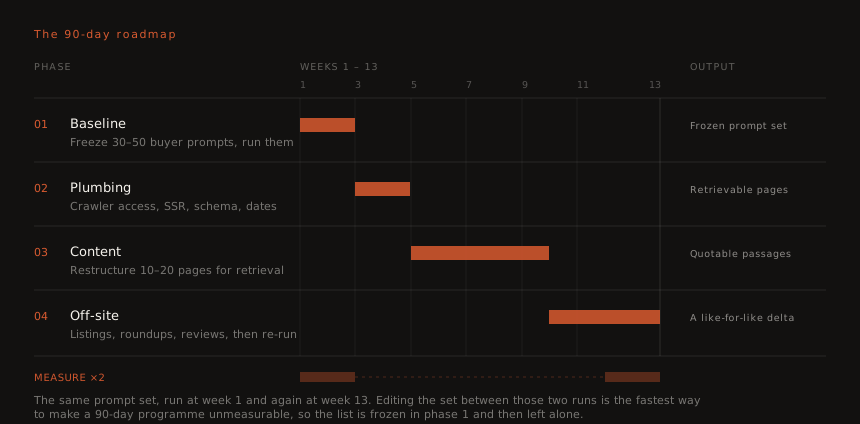
Weeks 1 to 2: baseline and prompt set
Write 30 to 50 prompts a real buyer would type, across problem-aware, solution-aware and vendor-aware stages, and freeze the list. Run them, record whether you are named, your position when you are, and which domains got cited instead. Freezing matters more than volume: a prompt set you keep editing produces a trend line that means nothing.
Weeks 3 to 4: unblock and fix the plumbing
The crawler table above, server-side rendering on the pages you want quoted, schema that matches visible text, dates and bylines. Finite, verifiable, and done once. If your robots.txt was blocking a search crawler, this is also the only phase in the plan that can produce a step change on its own.
Weeks 5 to 9: rewrite for retrieval
Take the 10 to 20 pages closest to your commercial prompts and restructure rather than replace: answer in the opening 60 words, self-contained sections, question headings, attributed numbers, a comparison table. Then fill the obvious gaps, which for most companies is the comparison and alternatives pages they have been avoiding writing.
Weeks 10 to 13: work the sources, then re-measure
Go after the specific third-party pages your baseline showed being cited: listings, roundups, review profiles, relevant threads. Re-run the frozen prompt set and compare. Expect movement on retrieval-driven prompts within weeks and nothing much on category priors for a couple of quarters. Report both honestly.
How to measure the success of GEO campaigns
GEO measurement has one hard problem: your primary outcome happens inside somebody else's product, leaves no referrer, and is non-deterministic. Analytics cannot see it. ChatGPT traffic mostly lands in your reports as direct. So the measurement has to be sampled, the way brand tracking always has been: fix a prompt set, re-run it on a schedule, and read the trend rather than any single answer. Treat it as testing rather than reporting: you are running the same experiment repeatedly and watching the result move.
Four rules keep the numbers honest. Freeze the denominator, because a visibility percentage over a changing prompt set is not a trend. Never score a failed API call as a non-mention, which is the most common way a GEO dashboard invents a decline that did not happen. Re-run on a fixed cadence rather than when someone is curious. And separate mentions from citations in your reporting, because conflating them hides which one you actually improved.
| Metric | What it answers | Read it as |
|---|---|---|
| Visibility / mention rate | In what share of our prompt set are we named? | The headline number. Only comparable over a frozen prompt set. |
| Share of voice | Of all brands named across the set, what share is us? | Competitive position. Moves when rivals move, so read it beside visibility. |
| Average position | When named, are we first or fourth in the list? | Quality of the mention. First-named carries most of the value. |
| Citation rate | How often is one of our own pages linked? | Whether your content is retrievable. Diagnoses technical and structure work. |
| Cited domains | Which sites are the answers built from? | Your off-site target list. The most actionable output of the whole set. |
| Prompt coverage | Which buyer questions do we lose entirely? | Your content roadmap, ordered by commercial intent. |
Getting from a percentage to a revenue figure
Nobody funds a mention rate. The bridge that works is a self-reported attribution question on your signup or demo form ("how did you hear about us?" with an AI assistant option), because it is the only instrument that catches the journey analytics loses. Run it alongside the sampled visibility trend and you have a defensible story: visibility rose on these prompts, AI-sourced self-reports rose behind it, those deals closed at this rate. AI search visibility KPIs works through that chain with a full example, and AI visibility metrics and KPIs is the shorter reference for each definition.
One caution on sentiment, since every vendor sells it: scoring whether a mention was positive means asking a model to grade another model's prose, and the result is unstable enough between runs that a change in the score usually tells you nothing about a change in the world. We deliberately do not report it. Read the answer text instead, which takes ten minutes a week and is genuinely informative.
Generative engine optimization software and platforms
The tool category is about two years old and crowded, and whether a product calls itself a GEO checking tool, an optimizer or a visibility platform tells you nothing: they differ less than the pricing does. Every one of them does the same core thing: run a prompt set against one or more engines on a schedule and store what came back. What separates them is whether you can trust the numbers and whether the output tells you what to do.
Four questions cut through a demo faster than a feature matrix, and the first is really about data transparency. Where does the data come from? A vendor that will not say whether it queries a consumer product, a public API or a grounded model is asking you to report a number you cannot explain to your CFO. Can you see the raw answers? If you only get a score, you cannot audit a decline, and you will get declines that are measurement artifacts. What happens on an API failure? The correct behaviour is to record nothing and retry; scoring it as a non-mention manufactures dips. Does it tell you what to change? A dashboard that reports you are at 34% without naming the prompts you lost or the domains that beat you has handed you a number, not a plan.
On free tools: a genuinely free tier that runs a real prompt set is the right way to start, because it gets you a baseline before you have committed budget to a category you are still learning. Our comparison of the AI visibility tools on the market goes through the options including the ones we do not sell, and the engine-by-engine trackers cover the platform-specific setup: ChatGPT, Gemini, Perplexity, Google AI Mode and AI Overviews.
CITED is our answer to those four questions. The free check researches your category's real buyer prompts, runs them through a grounded engine, and returns your visibility score, the competitors named instead of you, the exact domains the answers were built from, and a prioritised action plan. Every underlying answer stays visible, and a failed call is recorded as no data rather than as a miss. The recommended starting point is whichever tool gets you a frozen prompt set fastest. If you would rather a GEO expert ran it as a service, that is our GEO service, and the process behind it is written up in full.
Does GEO work for all types of websites?
It works wherever people ask an assistant for a recommendation before they buy, which is most considered purchases and very little impulse retail. The mechanics do not change by industry. What changes is which prompts matter and which third-party sources the engines trust for your category, and that difference is large enough to make a generic GEO plan mostly useless. An ecommerce site and a B2B platform can run the same process and end up working on entirely different pages, and the gap between what small businesses and what enterprises need is governance rather than technique.
| Business type | The prompts that matter | Where the leverage is |
|---|---|---|
| B2B SaaS | "best X for [segment]", "X vs Y", "alternatives to X" | The strongest fit of any category. Comparison and alternatives pages, plus review-platform profiles, which engines cite constantly. |
| E-commerce | "best [product] for [use case]", "is X worth it" | Product-level detail engines can quote: specs, materials, sizing, real reviews. Buying-guide content beats category pages. Product schema that matches the page. |
| Financial services | "best [product] for [situation]", "is X safe", "X vs Y fees" | Credentials and clarity. Named, qualified authors; explicit terms and fees; genuinely current data. See the note below on regulated markup. |
| Manufacturing / industrial | "supplier of X in [region]", "X specification", "who makes X" | Radically underserved, which makes it cheap to win. Publish real spec tables, tolerances and capability data instead of brochure prose. |
| Local / multi-location | "best X near me", "X in [city] open now" | Business profile completeness, consistent NAP, and reviews. Location pages need genuine local substance, not a city name swapped into a template. |
| Creators / publishers | "what is X", "how do I X", "who explains X well" | Being the source others cite. First-hand data and original research get quoted; aggregation of other people's does not. |
| Small business | A narrow set, often 10 to 20 prompts total | Focus is the advantage. One well-answered niche question beats broad coverage, and a free tool plus a frozen prompt set is a sufficient programme. |
| Enterprise | Hundreds of prompts across products, regions and languages | Governance. Prompt sets per business unit, one measurement standard, and the internal agreement that PR and content own this jointly. |
A note on financial services and other regulated markets
Regulated categories are the highest-stakes place to do GEO and the easiest to do badly, because the same content that wins citations can create compliance exposure. Three things are worth getting right before you publish anything.
First, credentials are not decoration here. A named author with a real, verifiable qualification is the difference between content an engine will build a financial answer on and content it will pass over, and it is also what a quality rater is looking for. Second, be careful with authority-claiming structured data. There is no GEO benefit to marking your pages up as regulated financial or medical content, and doing it without the credentials to back it up is a genuine risk; Organization, Article and FAQPage are the right set. Third, precision beats confidence. "Rates from 4.2% APR, representative example as of August 2026" is both quotable and compliant. "Market-leading rates" is neither. The GEO-optimal sentence and the compliant sentence turn out to be the same sentence, which is a happier outcome than most teams expect going in.
Challenges in implementing GEO: five ways programmes fail
Chasing referral traffic
The Pew numbers make this a losing target: 1% of visits produce a click inside an AI summary. A programme judged on AI-sourced sessions will look like a failure while the mention rate it should have been measuring doubles.
Reading noise as signal
The same prompt answers differently between runs. Teams re-run a prompt when they feel like it, see a drop, and hold a meeting about a change that was sampling variance. Fixed prompt set, fixed cadence, read the trend.
Editing the prompt set
The most common way to destroy your own measurement. Adding prompts you win and dropping ones you lose produces a beautiful chart of nothing. Freeze it, and version it if you genuinely must change it.
Treating it as SEO's problem
Most of the leverage is off-site: listings, roundups, review profiles, communities. Assign GEO to the SEO team alone and the on-site 20% gets done well while the 80% goes untouched. It needs content, PR and product marketing on one plan.
Expecting the model to change its mind quickly
Retrieval-driven answers can move in weeks. A model's prior about which brands belong in a category moves over quarters. Promising leadership the second on the timeline of the first is how GEO budgets get cut at month four.
The GEO audit checklist and implementation checklist
Twelve checks, in the order worth doing them. If you are starting from nothing, the first four will tell you whether you have a visibility problem or an invisibility problem, and those need different plans.
| Layer | Check | Passing looks like |
|---|---|---|
| Baseline | A frozen prompt set exists | 30 to 50 real buyer questions, written down, unchanged between runs |
| Baseline | You know your mention rate | One number, one date, one method you can describe |
| Baseline | You know who is named instead of you | A ranked competitor list from the answers, not from a guess |
| Baseline | You know which domains the answers cite | A source list. This is your off-site target list. |
| Technical | AI search crawlers are allowed | OAI-SearchBot, PerplexityBot, ClaudeBot, Googlebot not disallowed |
| Technical | Content is in the raw HTML | View source shows your copy, title, canonical and schema without JS |
| Technical | Schema matches visible text | Organization plus Article or Product, and nothing marked up that is not on the page |
| Technical | Quotable pages are fast | HTML returns quickly and reliably under load |
| Content | Each key page answers in its first 60 words | A standalone answer above the fold, before any warm-up |
| Content | Sections survive being lifted alone | 130 to 170 words, subject named, no "as mentioned above" |
| Content | Numbers carry named sources | Attributed and dated, ideally linked |
| Off-site | You appear in the roundups the engines cite | Listed and described correctly on the source pages your baseline surfaced |
The future of generative engine optimization
Two things look reasonably safe to bet on. The measurement will get harder before it gets easier: as answers personalise, a single visibility number for a brand becomes less meaningful and sampled, segmented measurement becomes the only defensible approach. And the tactical layer will keep getting commoditised. Answer-first structure and question headings are already table stakes rather than an edge, exactly as meta descriptions were in 2005.
What that leaves is durable and unglamorous: being genuinely worth recommending, being described consistently by people who are not you, and publishing things nobody else can because you have first-hand data. That is not a satisfying prediction for anyone hoping GEO is a settings change. It is also the reason the work compounds instead of expiring at the next model release.
If you want to know where you stand before committing to any of this, start with the baseline: run the free AI visibility check, or read our GEO process for how we run the 90 days above as an engagement.